

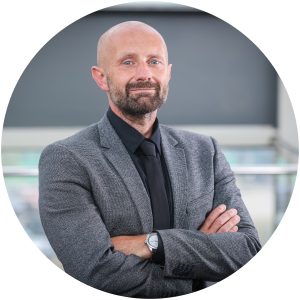
Marcin Świtoniak
He received his MA degree in Geography, with a specialization in ecological soil science, in 2002 from the Faculty of Biology and Earth Sciences at Nicolaus Copernicus University (NCU) in Toruń. In 2007, he obtained a PhD in Earth Sciences at the same faculty. Between 2008 and 2020, he worked as an assistant professor at the Department of Soil Science and Landscape Management, Faculty of Earth Sciences, NCU in Toruń. Since 2020, he has been employed as a university professor at the Department of Soil Science and Landscape Design, Faculty of Earth Sciences and Spatial Management, NCU in Toruń.
His scientific output includes over 170 publications, comprising six monographs, forty peer-reviewed journal articles, and forty-eight chapters in monographs. His total Impact Factor exceeds 40, and his h-index (Scopus) is 14. His research interests focus primarily on soil cover transformation under human pressure, including the influence of anthropogenic erosion in young morainic landscapes, the development of vertically texture-contrasted soils, and the role of soil denudation in the evolution of closed depressions. Additional areas of research include soil catenas, technogenic and anthropogenic soils, WRB soil classification, soil magnetic susceptibility, soil cartography, as well as the biological activity of Arctic soils. A significant part of his work is also devoted to soil science education and the development of innovative teaching approaches.
He has served as manager of two national research projects and as a participant in three subsequent grants financed by the Polish Ministry of Science and Higher Education (formerly the State Committee for Scientific Research). He was also the principal investigator of the international project Validation of the Central European Soil Database, funded by the Visegrad Fund.
A substantial part of his academic activity is dedicated to soil classification and education. Between 2012 and 2014, he coordinated international WRB workshops within the Erasmus LLP project Lingua Franca for European Soils (LiFES), organizing two-week summer schools for students from universities in Poland, Latvia, Hungary, and Lithuania. In 2015–2018, he coordinated the FACES project (Freely Accessible Central European Soils), focused on developing an international course on the latest version of the WRB soil classification, accompanied by teaching materials such as soil atlases, field guides, and online resources. From 2019 to 2022, he coordinated the SYStem project, aimed at creating edutainment-based social media and mobile tools supporting soil description and classification according to WRB standards.