

Tibor József Novák
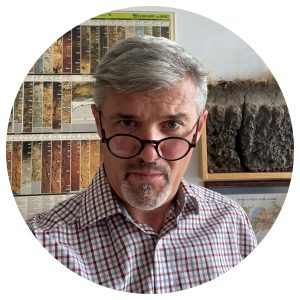
Tibor József Novák (born 1973) soil scientist and landscape ecologist in the Institute of Agrochemistry and Soil Science, University of Debrecen, Hungary. He joined Academia in 1997. He holds a PhD in Earth Sciences (2005), awarded for his dissertation ’Evaluation of Landscape Changes of a Sample Area in the Hortobágy Based on Soil and Vegetation Characteristics’, and obtained his habilitation degree in 2016 based on the thesis ’Soil diagnostics according to WRB guidelines as a tool for assessing anthropogenic impacts in landscape research’. In 2026 he was awarded with the doctoral degree of the Hungarian Academy of Sciences based on his dissertation ’Impact of landscape changes on soil anthropization in Hungary’. His research spans several complementary areas:
- salt affected soils, genesis, classification and landscape ecology
- soil genesis and classification, particularly human impacts on soil development, and related changes of taxonomic position
- soil organic carbon sequestration, land use change driven changes of soil organic carbon balance;
- soil and geoconservation, awareness raising and scientific dissemination about soil resources, vulnerability and conservation of soils and geosites
- environmental education, including translation of scientific classifications for broader audiences;
Dr. Tibor József Novák has long-standing involvement in professional scientific organizations. He is member of the ProGeo European Association for the Conservation of the Geological Heritage since 2020, the International Union for Quaternary Research – INQUA since 2015, the Hungarian Geographycal Society (1999), Hungarian Geological Society (2010) Hungarian Soil Science Society (2014-). He was awarded with the ’Sigmond Elek Award (2022) and for the Didactic Soil Science Photo competition (2017) of the Hungarian Soil Science Society, he holds the Pro Geographia Award (2019) of the Hungarian Geographical Society.
He participated several soil related educational Erasmus+ projects: LIFES, FACES and now ongoing SYStem and WRB educational workshops. He translated the 2006 and 2015 editions of World Reference Base for Soil Resources into Hungarian. His teaching activity is related recently to soil science, soil conservation, soil biology and soils as archive of landscape history.